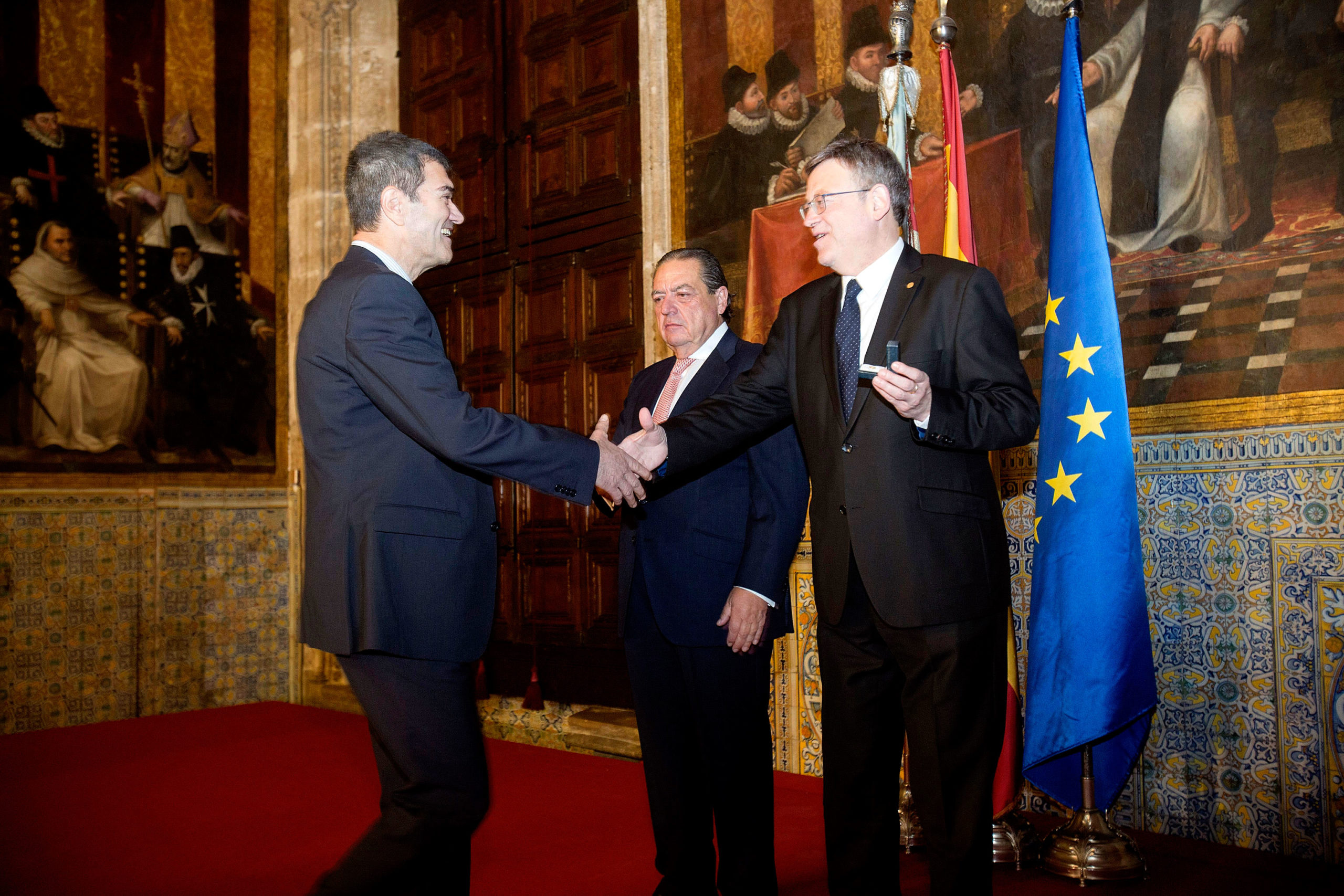
Hermenegildo García Gómez
New Technologies 2016Canals (Valencia), 1957. PhD in Photochemistry from the University of Valencia. Professor at the University of Valencia since 1996. He has been a member of the Institute of Chemical Technology, a joint centre run by the UPV and the CSIC, since its foundation in 1991.
A particularly noteworthy aspect of Prof. García’s work is that he has combined Basic Research with technological applications. As a university professor, this balance between research and development is one of his key achievements; a prime example of this has been his contribution to graphene technology. He has carried out his work in new technologies across four areas: renewable energy, improving environmental and water quality, catalysis and green chemistry, and nanotechnology. He has R&D&I contracts with more than 35 companies, including major Spanish and foreign multinational corporations, as well as Valencian, Spanish and foreign SMEs, and has more than 25 patents and products on the market.
Among the various processes that have been transferred from research to commercial application, photocatalysts and graphene technology stand out. The photocatalysts have three applications: a portable water purification plant that treats contaminated water; another for the remediation of soil contaminated by chemical warfare agents; and the third for the reduction of air pollution. Its aim is to produce natural gas or petrol using CO₂ and sunlight, in the same way that plants carry out photosynthesis.
As for graphene technology, the centre is developing new methods of production using biomass waste (prawn shells) and applications in the development of batteries, paints and plastic additives. The process represents a cost-effective method of producing graphene for a wide range of applications, such as the production of metallic paints for the automotive industry, water-based paints and photocurable paints. It also enables the incorporation of graphene into plastics and Teflon. Other fields in which he has successfully applied graphene range from additives to improve asphalt and ceramic coatings to its use as a fluorescent component in adhesives, in biomedicine and even in the controlled release of active ingredients in agriculture.
He holds an honorary doctorate from the University of Bucharest; is a Distinguished Professor at King Abdullah University in Saudi Arabia; a VIP Visiting Professor at the University of Ottawa; a Lee Hsun Lecturer at the Chinese Academy of Sciences; and a Highly Cited Researcher (Thomson-Reuter); Fellow of the Japan Society for the Promotion of Science (JSPS); and has received an award from the UPV for his dedication to research.
He is a member of the editorial board of the most important scientific journals in his field. He has published a total of 610 articles in international scientific journals indexed in the ISI and SciFinder Scholar databases in the fields of Chemistry, the Environment, Catalysis and Nanoscience, with an average of 35 publications over the last five years. His H-index is 79 (Google Scholar H-index 82) and the average number of citations per article is 40.2.
The jury for the Rei Jaume I New Technologies Prize, meeting in Valencia, has unanimously decided to award the 2016 prize to Hermenegildo García Gómez for his development of highly efficient heterogeneous-phase catalysts for processes, not only at laboratory level but also in the industrial sector, which have enabled the implementation of new technologies capable of addressing significant social challenges such as sustainable chemistry, renewable energy, atmospheric decontamination, carbon dioxide capture, and the development of new sensors with biomedical applications, amongst others. Recently, his research group has coined the term ‘carbocatalysis’, which utilises graphene and its derivatives—derived from agricultural waste—as heterogeneous catalysts in various chemical processes, such as the manufacture of plastics and paints, or the production of products that control the release of active ingredients in agriculture.