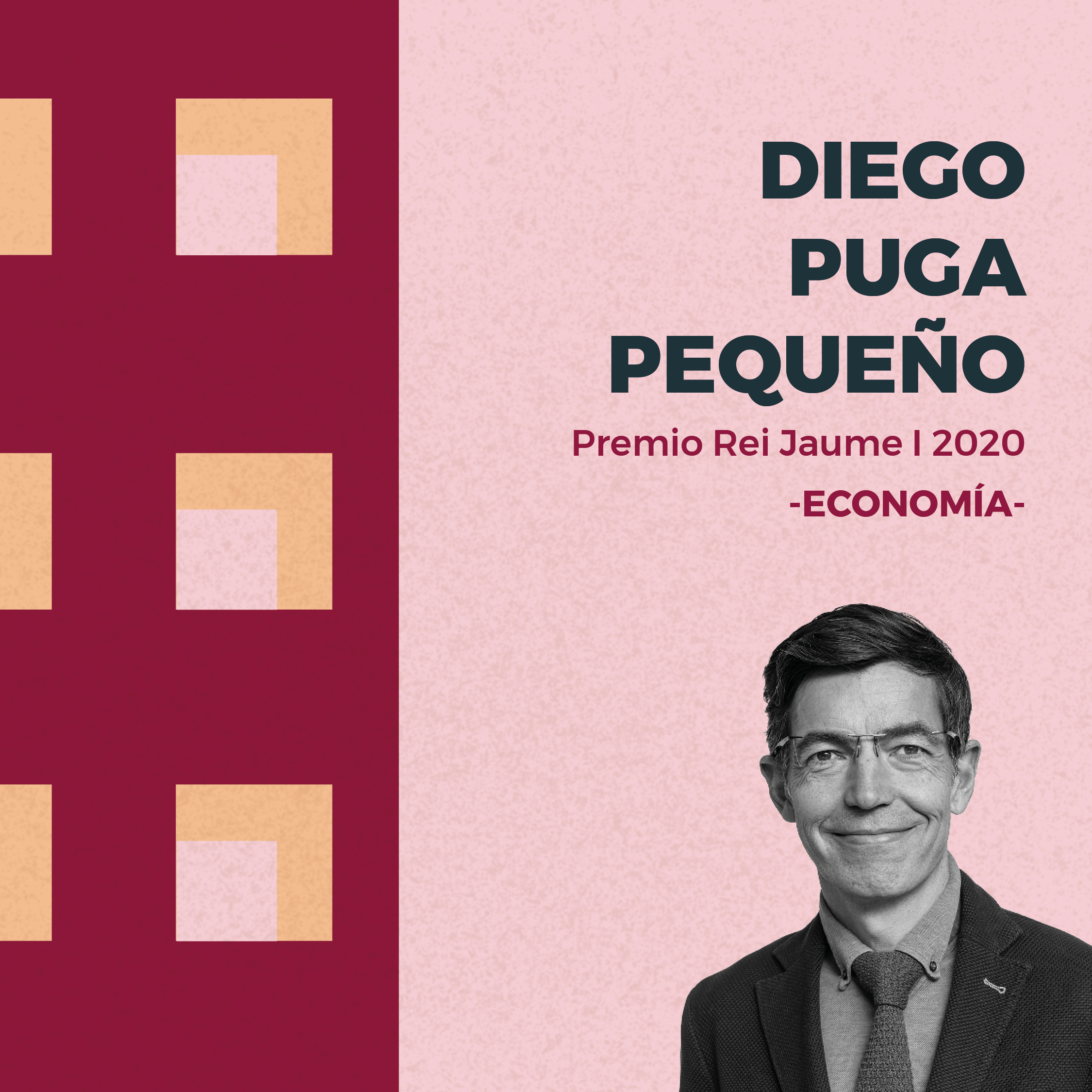
Diego Puga Pequeño
Economics 2020(Madrid, aged 51). PhD in Economics, London School of Economics and Political Science. Professor of Economics at CEMFI.
He has been recognised for his work in spatial economics, which includes urban economics, economic geography and international trade. Puga’s first influential contribution (Puga, European Economic Review, 1999) developed an integrated model of the so-called ‘new economic geography’. He has also conducted research into the productive advantages of cities. These advantages are reflected in higher productivity for firms and higher incomes for workers. His recent research proposes a new model of how cities and urbanisation interact with aggregate economic growth.
His work has been published in several of the leading generalist economics journals (including the American Economic Review, Econometrica, the Quarterly Journal of Economics and the Review of Economic Studies) as well as in other specialist journals. His articles have received over 4,800 citations in papers indexed in Web of Science and over 17,000 in Google Scholar. His h-index is 23 in Web of Science and 26 in Google Scholar.
His research has been funded, amongst other sources, by two Advanced Grants from the European Research Council (ERC) and three Standard Research Grants from the Social Sciences and Humanities Research Council (SSHRC) in Canada.
He is currently a member of the Multidisciplinary Working Group advising the Ministry of Science and Innovation on COVID-19.
The jury for the Rei Jaume I Prize in Economics, meeting in Valencia, has unanimously decided to award the 2020 prize to Mr Diego Puga Pequeño.
He has been honoured for his contributions to the field of spatial economics. This field encompasses urban economics, economic geography and that branch of modern international trade theory concerned with the problems of space-related costs. In this field, he is recognised as the most renowned economist of his generation. His contributions to the so-called ‘New Economic Geography’ proposed by Nobel Laureate Krugman opened up new perspectives. His work on the evolution of regional inequalities is essential reading. More recently, his contributions using ‘big data’ are transforming the traditional approach to phenomena linked to space.