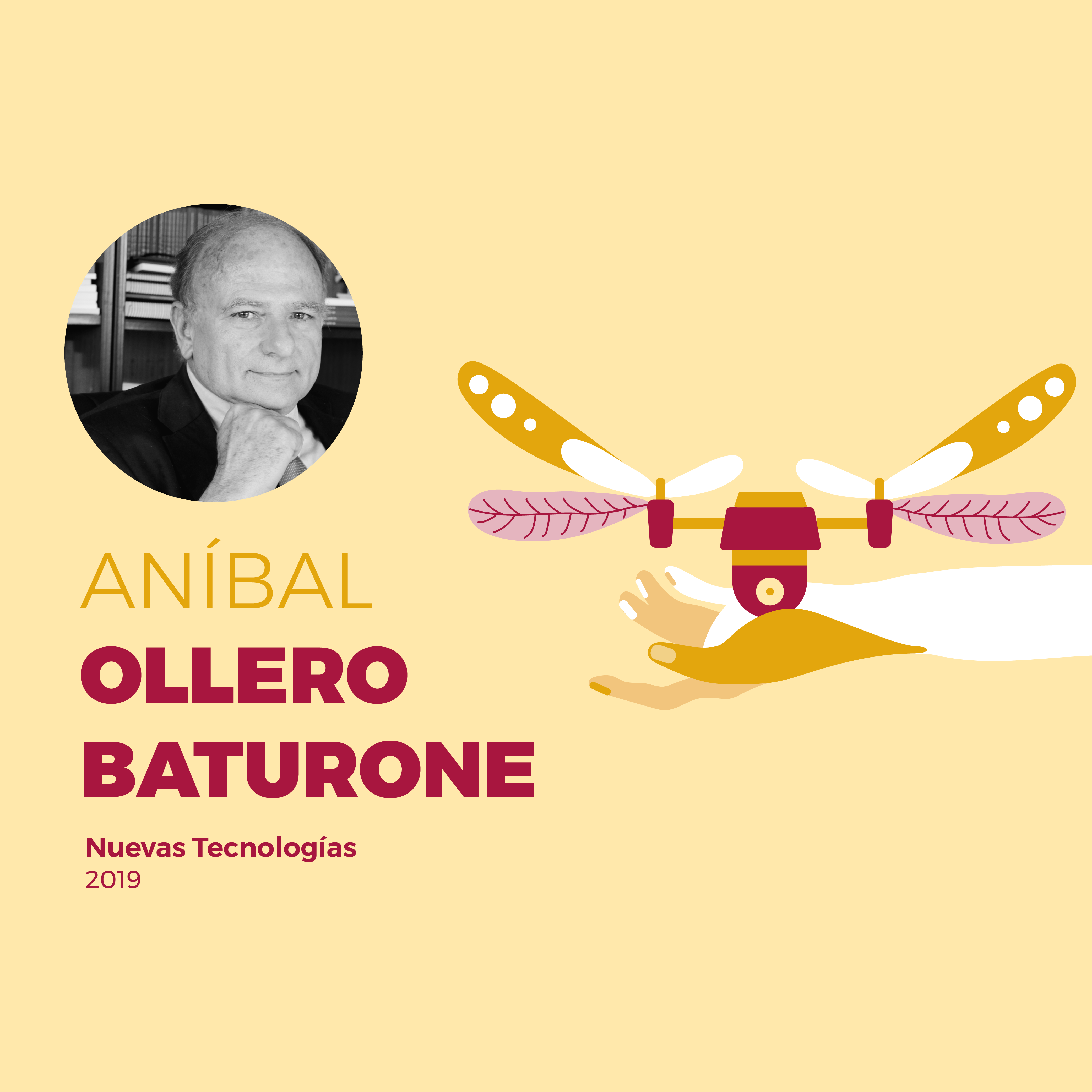
Aníbal Ollero Baturone
New Technologies 2019Doctor of Industrial Engineering. Professor at the University of Seville.
He has been a researcher at LAAS-CNRS (France) and at the Robotics Institute at Carnegie Mellon University, and has established successful research groups at the Universities of Santiago de Compostela (now Vigo) and Málaga, as well as at the Advanced Centre for Aerospace Technologies (CATEC).
The laboratory he heads comprises over 100 researchers who play a leading role in the field of aerial robotics worldwide, with 12 European projects currently underway, 2 Spanish projects and 10 contracts with companies. He has pioneered robotic methods and technologies for the first time anywhere in the world.
He is currently leading the ERC Advanced Grant GRIFFIN, coordinating the H2020 AEROARMS project, and serving as Chair of the IEEE Aerial Robotics and UAVs Technical Committee (IEEE RAS Award), of which he is a Fellow, and of the euRobotics Aerial Robotics Topic Group. With approximately 700 publications to his name, he is one of the world’s leading researchers in robotics and has some of the highest citation rates in this field.
He has transferred technologies to more than 20 companies, leading to the development of successful industrial products, including, amongst others, the automated aircraft test system currently used by Airbus DS to test the A400M, C235 and CN295, networked aircraft systems for Boeing, and NAVANTIA’s infrared detection and tracking systems
Jury rulingThe jury for the Rei Jaume I New Technologies Prize, meeting in Valencia, has unanimously decided to award the 2019 prize to Professor Aníbal Ollero Baturone. He is noted for his invaluable ability to combine excellence in research and technological innovation with the transfer of technology to businesses in the field of aerial robotics.
In recent years, he has developed new methods for the localisation and navigation of aerial robots with applications in logistics and the localisation of objects inside warehouses, for which he has received various international honours. He is also noted for his leadership in establishing the GRVC Robotics Group at the University of Seville in the 1990s, which has participated in several projects under the European Union’s Framework Programme.He is currently focused on developing bio-inspired aerial manipulators with unprecedented capabilities in terms of flight duration and safety when interacting with people, which will form the basis for future generations of drones.