
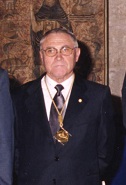
Agustín Escardino Benlloch
New Technologies 2002PhD in Chemical Sciences. Professor of Chemical Engineering at the Universitat Jaume I, Castellón. Director of AICE (Institute of Ceramic Technology)
Jury rulingThe jury for the Rei Jaume I New Technologies Prize, meeting in Castellón, has unanimously decided to award the 2002 prize to Mr Agustín Escardino Benlloch.
In the field of Ceramic Materials Engineering and Technology, he has carried out various studies on the devitrification process of different crystalline phases in the heterogeneous vitrified coatings of glazed ceramic tiles, during firing, as well as proposing a new kinetic model to interpret crystal growth in glasses (frits) during their heat treatment.
The creation, development, structuring and decision regarding the permanent location in Castellón of the Institute of Ceramic Technology (ITC), which he has directed since its foundation in 1969, is another of his contributions to the development of technology in the Spanish ceramics sector. He also spearheaded the creation, at the Castellón University Campus, of a specialisation in Industrial Chemistry within the Chemistry degree programme (from 1987 to 1998), with a particular focus on the processing of ceramic materials, and the launch of the Chemical Engineering degree programme.
During the 1990s, he promoted the launch and development of a company to manufacture inorganic pigments for colouring porcelain stoneware.
As an example of the technological development and industrial innovation that has taken place in the Spanish ceramics sector over the last fifteen years, it is worth noting that for more than ten years now, Spain has been the world’s leading producer of ceramic frits and glazes, and that in 1999 it became the leading producer of ceramic tiles.
These figures are even more significant when one considers that 92–95 per cent of Spanish production in both these industrial sectors is accounted for by companies located within a small geographical area in the province of Castellón, covering less than 300 km².

