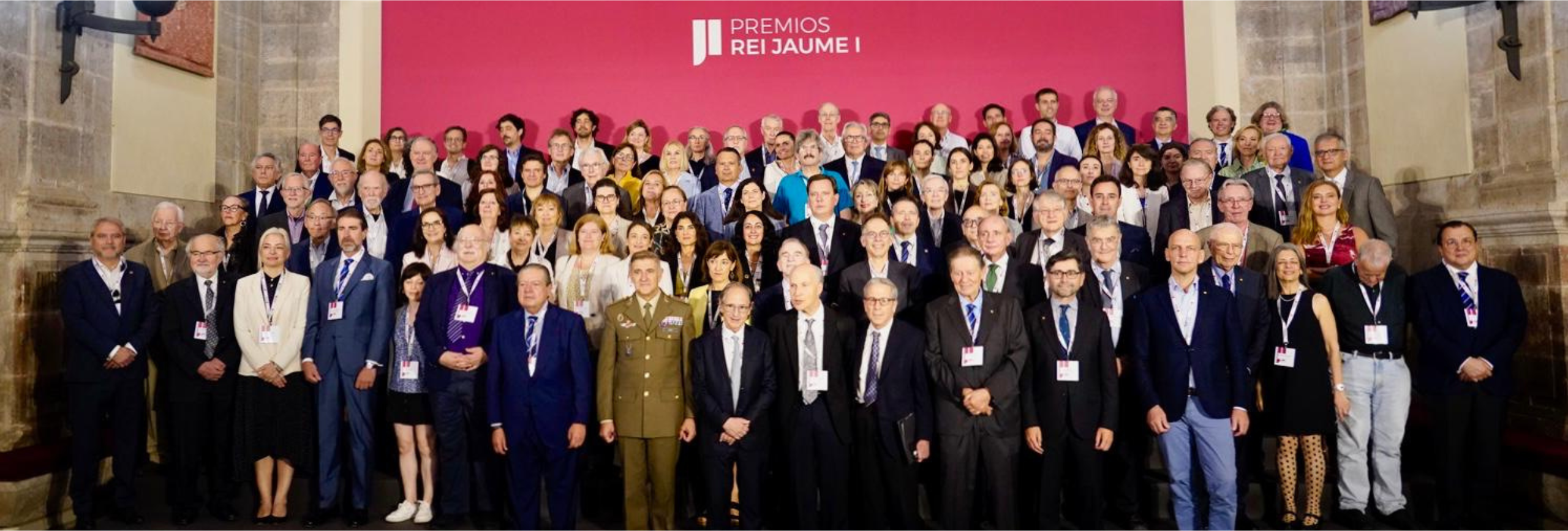
“There has been significant progress in terms of women’s participation in science and business, but cultural, educational and organisational barriers that hinder professional development still persist,” the participants at the Women, Science and Business Colloquium agreed
The Fundación Valenciana Premios Rei Jaume I (FPRJ) has held the tenth edition of the ‘Women, Science and Business Colloquium’, an event which, for a decade, has brought together leading female professionals to reflect on the evolution of women’s role in key areas for the development of society. Under the theme “A decade of change through a non-conformist lens”, the event served to analyse the progress made over the years and, at the same time, to identify the challenges that still remain.
Broadly speaking, all the female professionals on the panel agreed that generations have changed considerably, that there have been significant improvements and progress has been made, but that there are still major social and cultural factors to be overcome in order to achieve genuine equality. Similarly, they noted that in certain areas there is still significant scope for improvement in terms of women’s empowerment and self-confidence, and that further work is needed to support them.

The event, held at CaixaBank’s headquarters in Valencia, was attended by the winner of the 2025 Rei Jaume I Prize for Clinical Research and Public Health, Silvia de Sanjosé, businesswoman Myriam Gimeno, CEO of Nealis; technologist and economist Laura Olcina, managing director of ITI; and journalist and economist Rebeca Gimeno. The discussion was moderated by the journalist Pepa Fernández, director of the RNE programme *No es un día cualquiera*, who had previously hosted the first editions of this event.
Progress, but challenges remain
During the discussion, the speakers agreed that, over the last ten years, there have been significant advances in the representation of women in science, business and the media, although cultural, educational and organisational barriers that hinder professional development still persist.


Researcher Silvia de Sanjosé recalled how the medical profession has undergone a generational transformation in terms of the inclusion of women, although she pointed out that for many years female professionals have had to navigate predominantly male environments and, at times, face dismissive attitudes or stereotypes. In her view, one of the major challenges remains normalising motherhood within organisations, with adequate support structures to ensure that the burden of work-life balance does not fall exclusively on women, and she shared her own experience: “When it comes to motherhood, the blow suffered by a company or organisation when it loses an employee for a few months is significant, but we need to help those in management understand this. In one year, I had 12 pregnant women on my team, and management only provided me with one replacement; the rest of the workload had to be shared out. We need to provide more support if we want women to experience motherhood in a more normalised way.”
He has also put forward the idea that “why don’t we promote the three French concepts of liberty, equality and fraternity more widely, so that they encompass the whole of society and enable us to live in harmony? These humanist principles are what we must strive to pass on to our young people”.


For her part, businesswoman Myriam Gimeno has emphasised the importance of raising the profile of female role models to attract talent to certain sectors, particularly in fields traditionally dominated by men. However, she also pointed out that women themselves sometimes tend to avoid taking on greater professional responsibilities in favour of a better quality of life, which raises new debates about ambition, leadership and personal priorities.
Education and culture to break the cycle of inertia
The managing director of the Institute of Information Technology, Laura Olcina, has highlighted that the number of women in technology-related degree courses remains low — around 12 or 13 per cent in computer engineering — and has emphasised the need to encourage STEM careers from the earliest stages of education. She also warned that remote working, whilst facilitating a better work-life balance, can also be a double-edged sword if it reduces women’s professional visibility.


Speaking from the field of communications, Rebeca Gimeno pointed out that men continue to dominate economic journalism, particularly amongst sources and in management roles. In her speech, she highlighted how many women feel they have to work harder to prove their professional ability and referred to social dynamics that still assign women invisible tasks within the workplace – a phenomenon that some studies have termed the ‘coffee machine syndrome’.


New challenges in a changing landscape
The conference also addressed other emerging challenges, such as the impact of artificial intelligence on information and decision-making. The speakers warned that algorithms can reproduce existing biases in society, which means this issue must be addressed from an ethical and equality-based perspective.


The session also highlighted the generational shift in perceptions of feminism and equality, as well as the influence of social and cultural factors — including audiovisual content and social media — on the way in which younger generations interpret these issues.
Now in its tenth edition, the “Women, Science and Business Colloquium” has established itself as a forum for dialogue organised by the Fundación Valenciana Premios Rei Jaume I to raise the profile of female talent, encourage collective reflection and help build more equal professional environments