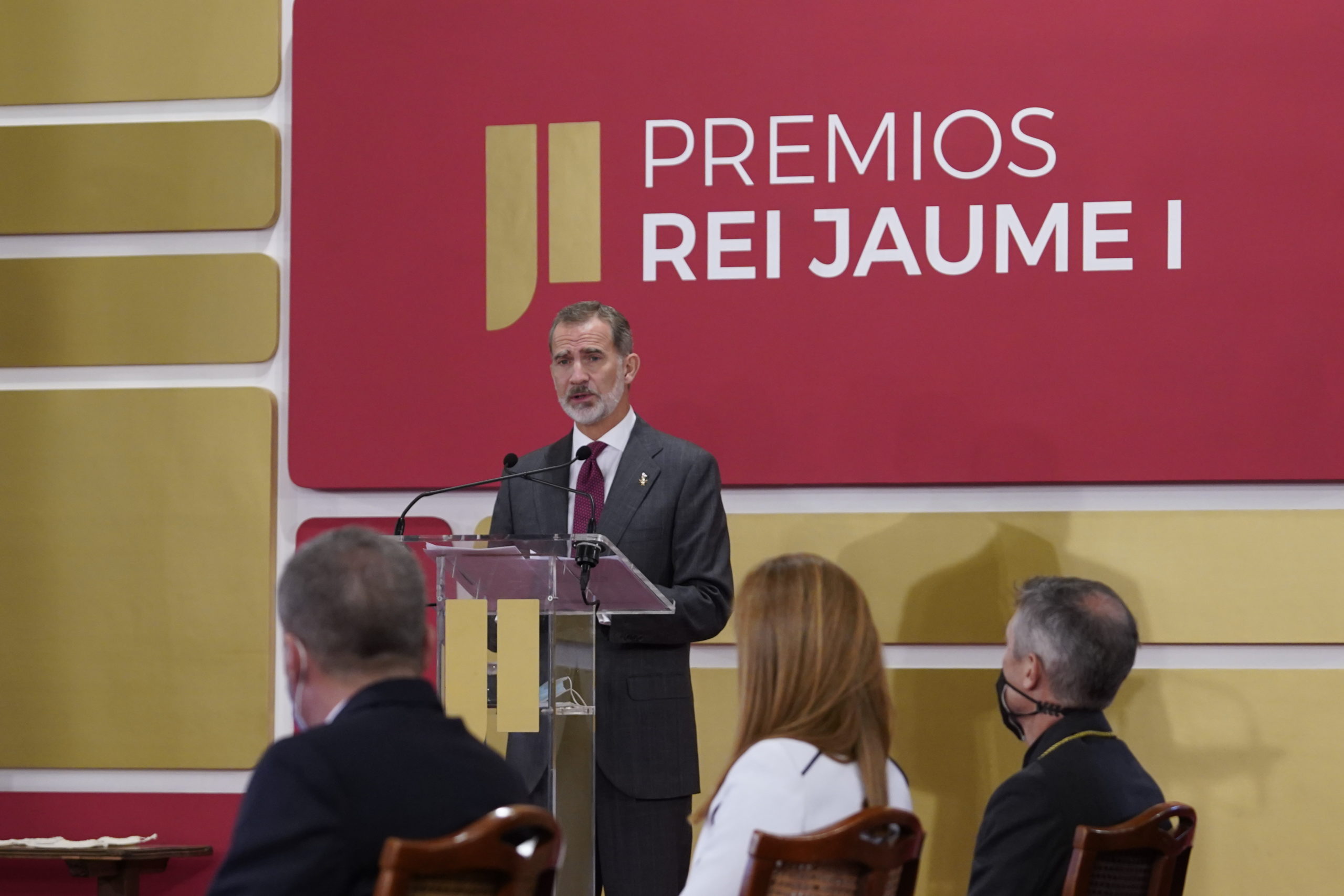
The Foundation is organising a course to raise awareness of a rare disease, Huntington’s chorea.
It is a condition that causes sudden, uncontrollable movements which make patients’ lives very difficult, and as it is largely unknown, they often lack the necessary social support.
Although it is a genetic condition, like all neurodegenerative diseases, it worsens with age and leads to the premature death of the patient.
The course featured Dr Minichiello, an Italian neuroscientist from the University of Oxford, who has over 30 years’ experience in research in this field and, for the last 15 years, has been working to explain the biochemical mechanisms that cause the death of a specific group of neurons responsible for coordinating our movements.
Another of the speakers was Dr Garcia de Yébenes, winner of the Rei Jaume I Prize for Clinical Medicine in 2000 and one of Spain’s most prestigious neurologists, as well as being a specialist in Huntington’s disease, who explained the chemistry involved and some treatments aimed at improving the quality of life for these patients, as there is currently no way to prevent or cure this disease.
In the words of the course coordinator, Dr López Ruiz from Cardenal Herrera University, “the aim of this conference is twofold. Firstly, we want to raise awareness amongst healthcare professionals and society in general of the need to learn more about this rare disease.” López thanked the president of the Fundación Premios Rei Jaume I, Javier Quesada, for his constant support for the medical conferences “despite not being an expert in this field”.
And Dr Bataller, coordinator at the University of Valencia (UV), expressed his satisfaction at being able to teach students “the importance of Basic Research in developing better treatments to prevent and combat these diseases”.
If you would like to watch the recording of the conference:
“The private sector has had to implement initiatives to ensure generational renewal and a pool of workers, but the city has significant educational shortcomings; there are no programs in the city of Valencia to study careers related to the sea and the Blue Economy.”
“Whoever controls maritime transport controls the global economy.”
“The job of Merchant Marine has wide employability. In 2023, 2.2 million ships entered the main ports of the EU.”
The Rei Jaume I Awards organize a day dedicated to maritime transport with specialized speakers in the maritime sector: “Blue Economy and Maritime Transport” organized together with Valencia Port, ANAVE, and Boluda Corporation.
The Valencian Foundation Rei Jaume I Prizes (FPRJ) held the first day dedicated to professional opportunities in the maritime transport sector. For this, it had the help in organizing from Boluda Corporation, Valencia Port, and the ANAVE Association.
At the inauguration, Mar Chao, president of the Valencia Port Authority, highlighted the Port of Valencia as “an engine of responsible growth committed to the environment.” Vicente Boluda, president of the Rei Jaume I Prizes, AVE, and ANAVE, who always has words of gratitude for Professor Santiago Grisolía, also warned about the current lack of personnel in the maritime sector. For his part, the Minister of Environment, Infrastructure, and Territory, Vicente Martínez, emphasized that “the Community has 500 km of coastline, around 15% of GDP is generated in the maritime strip, and more than 70% of the population lives around the coastal strip,” committing to protect it “with the utmost respect for the environment.”
The day began with a talk by the general director of ANAVE (Spanish Shipowners’ Association), Elena Seco, who spoke about the “Sectoral Coordinates and Current Overview of Maritime Transport.” Seco explained why maritime transport is essential for the economy of countries, especially for a continent like Europe. “There is no other means of transport capable of moving the quantities of goods that maritime transport does; whoever controls maritime transport controls the global economy, as we are seeing with Donald Trump and his initial political actions.”
“Spain is the third country in the world in global transport,” confirmed Seco, “and the fifth in passenger transport, but 10 billion euros of our balance depend on other countries that are not ours, and Spain is only the 12th country in the European economic area by fleet controlled by its national shipowners. And according to a study by the cluster, maritime transport is the blue economy activity that induces the most added value,” he concluded.
He was followed in the turn of interventions by the head of the maritime training area, Francisco Javier Benítez, who explained “the career of a merchant marine: values and attributes of a profession with a future.”
Benítez, head of the maritime training area at the Directorate General of the Merchant Marine, commented that this profession “can provide values in multidisciplinary work teams in different areas of the blue economy: shipbuilding, port public works, appraisal, port sector, recreational boating, auxiliary industry, research, and training in nautical sciences and maritime tourism.” For the highest authority in training in the Merchant Marine, the job of a merchant marine “has high employability: thus, in 2023, a total of 2.2 million ships entered the main ports of the EU, which means a need to fill job positions.” Benítez spoke about the near future, which will be “in operating autonomous vessels up to 25 meters and, as an immediate future, the creation of professional titles for port traffic in accordance with the STCW.”
Jorge Olcina, professor of regional geographical analysis at the University of Alicante, concluded the session by discussing “Climate change, risk management, and sustainable development,” presenting climate change as an opportunity: “Against climate extremism, the commitment should be to science and avoiding magical solutions.” Olcina proposed four types of planning: territorial, hydrological, economic, and emergency planning, and called for a socio-cultural change as an opportunity to do things right.”
After the break, a round table was held moderated by journalist Paco Prado, founder and director of Grupo Diario del Puerto, featuring Antonio Torregrosa, manager of the Valencia Port Foundation; Francisco Tirado, HR director at Boluda Corporation; Mercedes Pardo, CEO of the Spanish Maritime Institute; Javier Garat, president of the Spanish maritime cluster; and Gustavo Santana, director general of the Merchant Marine.
Tirado acknowledged that “Valencia continues to turn its back on the sea and we have not been able to transmit or promote a sector with a lot of potential.” He also confessed that “the private sector has had to launch initiatives to ensure generational replacement and a pool of workers, but the city has significant educational deficiencies; there are no studies in the city of Valencia to study careers related to the sea and the blue economy.” He has advocated for “the role of Boluda’s firm to reach agreements in more than 60 centers to cover these shortcomings.”
Mercedes Pardo said that the company must approach the candidate and retain them and defended the measures her institute has taken to facilitate generational replacement in addition to advocating being present at job fairs, study fairs, career fairs, etc. to explain to young people what the professions related to the blue economy consist of.
Garat has proposed linking the maritime world with our young people, “that is our pending subject. It is necessary to raise awareness in society about the blue economy and its multiple possibilities and career opportunities. An attractive sector and a stable legal framework are needed, with competitive companies that generate wealth and employment with the same rules and regulations for everyone. Speaking the language of young people and being present on social media.” Meanwhile, Santana has insisted that “there is a deficit of maritime professions, it is a beautiful but very hard profession. We want to attract young people, but the youth cannot be aligned.”
To conclude, the round table moderator, Paco Prado, agreed that we have a problem of a lack of vocations and personnel, and acknowledged that “we need to make a self-critique regarding the lack of communication to society to attract and secure more workers. The training exists, but it is insufficient. The sector is passionate,” he emphasized, “but we need to motivate young people, inform them, and coordinate that information. It is a privileged sector with more and more job opportunities that need to be communicated.”
The event was closed by Benito Núñez, Secretary General of Air and Maritime Transport, who confessed that, as a naval engineer, he sees “how we are facing a different world where, to attract vocations and new workers, we will have to treat them very well if we do not want them to move to other sectors. The generational replacement in the maritime sector in Spain and Europe hinders technological capacity, which will become a drama.” He concluded by encouraging the pursuit of “initiatives such as promoting the generation of vocations through exercises of transparency and openness to society.”
The event was held at the Edificio del Reloj at the Port of Valencia, before an audience that filled the main hall where the event was moved due to full registration capacity.
The King presided over the solemn ceremony of the Rei Jaume I Prizes 2024, held, as every year, in the Lonja de los Mercaderes building in the city of Valencia. This is the 36th edition, which was scheduled for November 2024 but was postponed due to the consequences of the DANA.
Antonio Acín (Basic Research), Francisco Pérez (Economics), Xavier Trepat (Biomedical Research), Sergio M. Vicente (Environmental Protection), Luis Serrano (New Technologies), Víctor Amarnani (Entrepreneur), and Jordi Sunyer (Clinical and Public Health Research) received from King Felipe VI the medal that certifies them as winners in their respective categories.
With the participation of experts, bakers, and chefs, this initiative aims to establish carob flour as a key ingredient in modern, healthy, and sustainable hospitality and food.
The Foundation held the first event dedicated to new gastronomic products made with carob flour. The goal is to solidify this initiative of considering carob as a key ingredient in modern, healthy, and sustainable hospitality and food, with the participation of experts, bakers, and chefs.
The event was inaugurated by the Regional Minister of Agriculture, Water, Livestock, and Fisheries, Miguel Barrachina, followed by the participation of the head of the Fruticulture section of the regional Ministry of Agriculture, Water, Livestock, and Fisheries, José Malagón, and a speech by the director of the Institute of Agrochemistry and Food Technology (IATA-CSIC), Amparo López.
Then, Michelin-starred chef Maria José Martínez from Lienzo restaurant and the president of the Guild of Bakers of Valencia, Juan José Rausell, spoke. Rausell stated, “Bread should be crunchy with music and sourdough in a long fermentation process. It is important to incorporate carob, especially with the 70% increase in cocoa prices, but we cannot do it without an institutional campaign.”
In the subsequent roundtable, food critic Santos Ruiz from Levante-EMV newspaper emphasized “the emotional value of the ingredient” and stated that “the future of agriculture is heavily dependent on government support.” Santos Ruiz criticized that European politicians “are more moved by the emotions of their voter-citizens than those of the farmers.”
At the end, there was a tasting of products made with carob flour presented by the director of PROAVA, Rosa Vázquez, who stated that “the carob surface area in Valencia represents 44% of the total in Spain” and called for “carob flour, vinegar, or syrup to be incorporated into the consumer’s daily routine.”
The seven winners of the Rei Jaume I 2024 Prizes, Antonio Acín (Basic Research), Francisco Pérez (Economics), Xavier Trepat (Biomedical Research), Sergio M. Vicente (Environmental Protection), Luis Serrano (New Technologies), Víctor Amarnani (Entrepreneur) and Jordi Sunyer (Clinical Research and Public Health) have explained this morning, to the media and this afternoon to businessmen, academic world and society in general, their corresponding lines of research for which they have received this recognition.
When asked by journalists about the consequences in different areas of the policies being implemented by the U.S., the winners agreed that they will be very negative for all sectors, economic, environmental and research. However, they all pointed out that these policies will also be counterproductive for the American country itself and can become an opportunity for the rest of the states. For example, firstly to attract the talent of American scientists and scientists of other nationalities who have so far been attracted to this country, but who now, due to uncertainty about migration and the discrediting of science, may wish to seek other places.
Basic Research, Economics and Biomedical Research
The Rei Jaume I Prize for Basic Research 2024, Antonio Acín, holds a PhD in Theoretical Physics from the University of Barcelona, a degree in Telecommunication Engineering, Polytechnic University of Catalonia (1997), and a degree in Physics, University of Barcelona (1997). He is ICREA professor at ICFO-Instituto de Ciencias Fotónicas.
“Quantum physics provides better quantum computers that can solve problems better, also security with quantum cryptography” stated Acín. “It is now an information paradigm shift as our understanding of information has changed with quantum physics.”
In the economic area, Francisco Pérez, Economics 2024 winner, PhD in Economics from the Universitat de València. Professor of Economic Analysis. Professor Emeritus and Director of Research at the Valencian Institute of Economic Research. In his more than 50 years of research activity, he has specialized in economic growth and competitiveness, regional economy, economics of education, banking and public finances.
“Our research for years,” explained Perez,” has focused its efforts on measuring value in all sectors. Knowledge is valuable because it increases our ability to provide effective and efficient solutions to society.
Xavier Trepat, winner of the Rei Jaume 2024 Prize for Biomedical Research, holds a degree in Physics (University of Barcelona, UB, 2000) and in Electronic Engineering (UB, 2002). D. from the Faculty of Medicine of the UB (2001-2004). In 2004, he moved to the Harvard School of Public Health to do postdoctoral work after obtaining a Ramón y Cajal fellowship, and in 2011, he obtained an ICREA researcher position to create and lead the group “Integrative Cell and Tissue Dynamics” at the Institute for Bioengineering of Catalonia (IBEC). In addition, he is a member of CIBER-BBN (since 2016), member of EMBO (since 2018), and Banco Sabadell Award for Biomedical Research (2015) and Constantes y Vitales Award (A3Media, 2021).
“I have always been curious about building bridges between the world of cells, to understand them,” Trepat began. What we do is to build those bridges, in my case, between physics and medicine, one of them is in cancer,” he said.
“We develop technologies to measure the strengths of healthy cells over tumor cells. Physics tries to understand the movement and the arrival of healthy cells to kill the bad ones. We create a chip in the lab and use it to test therapies, or personalized therapies,” said the Catalan researcher.
Environmental Protection, New Technologies, Entrepreneurship and Clinical Research and Public Health.
The Rei Jaume I Environmental Protection Prize 2024, Sergio M. Vicente-Serrano is PhD. in Physical Geography from the University of Zaragoza (2004). Professor of the Spanish National Research Council and Master in Remote Sensing by the Institute of Spatial Studies of Catalonia (2000). He has participated in more than 45 R&D projects, coordinating two research projects at European level, and has published more than 400 scientific papers, including more than 275 articles in international journals in the fields of water resources, atmospheric sciences, remote sensing, ecology, etc.
As Sergio Vicente explained, “droughts have multiple impacts, crops, forest fires, and especially in developing countries due to famine. Droughts have been one of the biggest shapers of history, migrations, wars…but it is a very complex phenomenon and difficult to measure.”
The winner explained that “throughout my career, we have worked on three lines related to the problems, the first one is how to measure it (tools, analysis), the second one is how these droughts are (how are their mechanisms, etc.) and finally on the impact of these on the different sectors”
Luis Serrano, winner of the Rei Jaume I New Technologies Prize, is a PhD in Biochemistry and Director and Senior Group Leader at the Centre for Genomic Regulation (CRG). Luis Serrano is a visionary scientist known for his fast progress in merging fundamental research with innovative health solutions.With nearly 400 publications, an h-index of 95 and an average citation rate of 92.5, Serrano’s career started with a PhD at the CBM in Madrid and a postdoc with Prof. A.R. Fersht in the UK. His leadership at EMBL Heidelberg as head of the Structural and Computational Biology program and as director of the Barcelona CRG has been instrumental in achieving scientific excellence in Europe and has made the CRG a leader in Systems Biology and Biomedical research.
Serrano told that, in his laboratory, he is dedicated to “using a living being, a bacterium, to inject it into the body so that it goes to the site of the disease and that living being produces the molecules we need to overcome that disease is what we do, and the advantage of using a living being is that it can measure the environment in which it is introduced and have greater or lesser effect.” Serrano nevertheless warned that “today we have the tools to change the genome, but we still don’t know how to do it and when we find out we will have an ethical problem.”
The 2024 Entrepreneur Winner is Victor Amarnani CEO of A4B Group Corp (BigBuy Group). BigBuy is a fast-growing company, currently with 300 people on staff between several companies within the group. BigBuy has created a unique business model, totally disruptive and pioneering from the Valencian Community to the whole of Europe; a 360º proposal to boost digital sales for our customers, taking advantage of trends such as Full-Commerce or Omnichannel.
According to the winner, “we are a bridge between suppliers that have products (factories, etc.) that want to enter the digital market because we provide them with digital retailers to whom we give access to that catalog and to the technology developed for us. In addition, you can sell through the web, social networks, marketplace”.
The winner of the last category, Clinical Research and Public Health, Jordi Sunyer, is an internationally recognized leader in the environmental origins of asthma and COPD, and neurodevelopment. His scientific work began by finding and abating asthma epidemics in Barcelona in the 1980s.
This gave him the desire to prevent people from getting sick and allowed him to participate in the development of Public Health in Spain, first by co-creating the epidemiology department of IMIM and later on by creating the center for environmental epidemiology (CREAL) which has recently become ISGlobal.
Sunyer explained how, in the 1980s, “an epidemic of asthma appeared in Barcelona that collapsed the emergency services and after an investigation, they managed to find out where it came from, particularly from an atmospheric cause in the port of Barcelona”.
As a result, his career focused on research into the causes of asthma and lung diseases, especially in the early years of life.
To conclude, this year’s seven winners held a colloquium, that you can see:
The King presided over the solemn ceremony of the Rei Jaume I 2024 Prizes, held, as every year, in the Lonja de los Mercaderes in the city of Valencia. This is the 36th edition, which was scheduled for November 2024, but was postponed due to the consequences of the DANA.
Antonio Acín (Basic Research), Francisco Pérez (Economics), Xavier Trepat (Biomedical Research), Sergio M. Vicente (Environmental Protection), Luis Serrano (New Technologies), Víctor Amarnani (Entrepreneur) and Jordi Sunyer (Clinical Research and Public Health) have received from King Felipe VI the medal that accredits them as winners of their respective categories.
Institutional Interventions
The mayoress of Valencia, Mª José Catalá, began her speech by thanking His Majesty for his support for these prizes and “for his presence at a particularly difficult time for the Valencian people”. Catalá remarked that “the wealth of a country should not be measured only in economic terms, but also in its ability to generate talent and with it a positive impact on people’s lives. And that is what is being recognized today. The world faces many challenges. Climate change is a fact, and we must anticipate, prepare ourselves and protect our neighbors. And we can only do that with knowledge. Science is the solution.
In his speech, the president of the Valencian Foundation Rei Jaume I Prizes, Vicente Boluda, wanted to recognize King Felipe VI for the “solidarity, empathy and affection shown towards our land, and towards the victims of the DANA of October 29th, being always on the side of those affected by the disaster, stepping on the ground on many occasions and attending the funeral of the victims”. In addition, in his speech he wanted to point out four lessons from the catastrophe, the fourth of them: “is that science and research produce advances and innovations that our companies can implement and, thus, not only allow us to have more accurate diagnoses, but to work for the reduction the environmental impact of our developments. Undoubtedly, science, research, technology and business are the pillars on which we must base our present and our future. And we must work on the basis of these pillars so that what has happened does not happen again”.
This year Luis Serrano, winner of New Technologies prize, spoke in behalf of the seven winners and after thanking them for the prize he had a fond memory towards the team of research group, “Without dedication, effort and intellectual contribution we would not have been worthy of this prize, and therefore, they are part of it”. In his speech he claimed that, although Spanish science has achieved great advances and contributed to notable successes, “science still does not occupy the place it deserves in the Spanish public conscience, nor is it valued with the pride it should be […] we are still far from the level of investment we should be making in science in proportion to our economy. For all these reasons, I believe that prizes like this are essential to highlight the value of science and innovative entrepreneurial activity in our country and to convey to our young people that science and entrepreneurship are fun, exciting and fundamental for the progress of humanity, and that in this country of ours we believe in and are committed to them”.
The President of the Generalitat, Carlos Mazón, said that “the hope of advancing towards normality of so many Valencians, makes sense inside the walls of this Lonja. The genius of those who help us move forward is recognized every year. That is why I want to recognize the difficult task of the prestigious jury of these prizes, which each edition has the challenge of recognizing the best among the excellent ones. These prizes are proof that our country has a great mass of talent. What is created is always magnificent. Our companies have understood that anchoring themselves to science and innovation is the future”.
Finally, HM King Felipe VI began his speech by remembering those affected by the DANA and encouraging everyone to continue with their efforts, solidarity and responsibility in order to recover. He also recognized the prizes and their winners, “The Rei Jaume I Prizes continue to weave links between science and technology, innovation and entrepreneurship. And he stressed that “in these times, open and constructive dialogue between those who create knowledge and those who apply it is a necessity that cannot be postponed”. “But these prizes are a great value for society because they highlight, through the example of the winners, the enormous importance of strengthening the synergies between innovation and entrepreneurship, between social value and economic value, and between competitiveness and prestige or image of the country”.
This year’s edition was once again attended by representatives of civil, political, economic and social society, among the nearly 400 people who attended the ceremony. Among them, the trustees of the Rei Jaume I Prizes Foundation, the jurors present, family members and representatives of the collaborators: Iberdrola Foundation Spain in Environmental Protection, Valencia City Council in New Technologies, AirLiquide Healthcare and CaixaBank in Biomedical Research, Mercadona, Edem and AVE in the Entrepreneur Prize. In addition, entities such as the Port Authority of Valencia, Boluda Corporación Marítima, Council of Chambers of Commerce of the Valencian Community, Banco Santander Foundation, Pavasal, RNB, SPB, Vectalia Group, CEV, Provincial Council of Valencia, Logifruit, Torrecid Foundation, BP, Empresas del Sol, Provincial Council of Alicante and Segura-Balpa Group also collaborate in the prizes.
Utilizamos cookies propias y de terceros para analizar nuestros servicios y mostrarte publicidad relacionada con tus preferencias en base a un perfil elaborado a partir de tus hábitos de navegación (por ejemplo, páginas visitadas). Puedes obtener más información y configurar tus preferencias aquí.
Este sitio web utiliza cookies para mejorar su experiencia mientras navega por el sitio web. De estas, las cookies que se clasifican como necesarias se almacenan en su navegador, ya que son esenciales para el funcionamiento de las funcionalidades básicas del sitio web. También utilizamos cookies de terceros que nos ayudan a analizar y comprender cómo utiliza este sitio web.
Estas cookies se almacenarán en su navegador solo con su consentimiento. También tiene la opción de optar por no recibir estas cookies. Pero la exclusión voluntaria de algunas de estas cookies puede afectar su experiencia de navegación.