The 37th meeting of the juries for the Rei Jaume I Prizes will be held on June 2 and 3.

The Foundation launches the “Deliberación Triunfo” campaign aimed at younger generations to promote and retain scientific talent.

● A total of 20 Nobel Laureates, four of whom will be attending for the first time, will be part of the jury that will select the seven laureates.
● Female nominations have increased by 25%, accounting for more than a third of the 226 candidates, while more than half of the panel is made up of women.
● As a new development, two Nobel Laureates will visit the Benetússer High School, which was affected by the DANA earthquake last October.

The traditional Jury Meeting will be held in Valencia on June 2 and 3. The jury will determine the seven winners of the 37th Rei Jaume I Awards 2025 in the following categories: Basic Research, Economics, Biomedical Research, Clinical Research and Public Health, Environmental Protection, New Technologies, and Business Revelation.
The Executive President, Javier Quesada, and the President of the Valencian Foundation for the Rei Jaume I Prizes, Vicente Boluda, were responsible for presenting the latest developments for this year’s awards.

This year, the jury will be composed of nearly 100 people, of whom 20 are Nobel Laureates in different disciplines, four of whom will be serving as jurors in Valencia for the first time. They are Dr. Guido Imbens, 2021 Nobel Laureate in Economics (Netherlands-USA); Dr. Duncan Haldane, 2016 Nobel Laureate in Physics (USA); Dr. Douglas Diamond, 2022 Nobel Prize in Economics (USA); Dr. Charles Rice, 2020 Nobel Prize in Medicine (USA).

As every year, as part of the Nobel Laureate program, they will visit various research centers and universities. In addition, as a novelty this year, two of them will visit the María Carbonell Secondary School in Benetússer on Monday, June 2nd, one of the schools affected by the DANA that struck the southern region of Valencia. There, they will have the opportunity to meet students in the final years of secondary school and high school, and will be able to speak and interact with the young students.

The Jury Meeting is the only event in Europe that brings together such a significant number of Nobel Laureates. Furthermore, as every year, the jury will include the country’s leading businessmen and women, as is customary every year on the jury for the Business Revelation Prize.

A total of 226 nominations
A total of 226 people, 25% of whom are women, are applying this year to be one of the seven recipients of the Rei Jaume I Prizes dedicated to the promotion of Research, Science, and Entrepreneurship. The awards will be decided next June by a jury of more than 100 people, including 20 Nobel Laureates.
Female nominations have increased by 25% and now represent more than a third of the 226 candidates, while more than half of the panel is made up of women.

Creative Campaign
As every year, the Jury Meeting is used to attract public attention with a creative campaign that aims to raise awareness of the importance of innovation, science, and business for any country. This year, the focus is on science, research, and entrepreneurship, and to advocate for the retention of talent in Spain, under the title “Deliberation Triumph.”
Thus, coinciding with the launch of the famous reality show, Operación Triunfo, the aim was to equate the search for musical talent in this competition with the search for scientific and business talent. There is enormous talent in music, and those dedicated to it enjoy great visibility, thanks, for example, to programs like this one, which seeks to find the best voice in the country. But among many other talents, there is also that of science, research, and business creation. Areas that, despite their impact on society, rarely receive the same attention, “Because we all know that Spain hasn’t won Eurovision for years, but it’s been even longer since we won a Nobel Prize in science. At the Rei Jaume I Prizes, we work not only to recognize and reward those who excel in science and business, but also to give them the visibility they deserve,” Javier Quesada noted.

Events on June 2 and 3
As every year, a full program of events has been prepared, beginning on the morning of June 2 with visits by the Nobel Laureates to various research centers and universities in Castellón, Valencia, and Alicante, as well as to the Maria Carbonell High School in Benetússer.
In the afternoon, there will be lunch with students and doctoral students, where the young people will be able to share a table with some of their leading figures. And in the evening, there will be discussions with the Nobel Laureates. Dinner will be hosted by Valencia City Council, and the Príncipe Felipe Museum has been specially chosen to commemorate its 25th anniversary.
The following day, June 3, the program will remain unchanged from previous years. The day will begin at the Captaincy General, the former Convent of Santo Domingo, with the reading of the Jury’s “Declaration.” The juries will then meet to decide who will be the seven laureates of the 37th edition. Afterwards, the winners will be announced at the Palau de la Generalitat at around 1:30 p.m.

THE REI JAUME I PRIZES SNEAK INTO THE OT CASTING TO VINDICATE TALENT IN SCIENCE AND BUSINESS

‘Deliberación Triunfo’ is the creative campaign with which the Valencian prizes seek to ensure that the voices of those who research, undertake, and transform the country are also heard.

The Rei Jaume I Prizes Foundation has taken advantage of the auditions in Valencia of the popular television program, Operación Triunfo, to vindicate talent in science and business. This is the new creative campaign, Deliberación Triunfo, with which the Valencian prizes seek to highlight those who research, undertake, and transform the country.

While thousands of young people lined up to sing at the casting call for the new edition of Operación Triunfo, a scientist auditioned with a very different objective: to remind everyone that, although scientists don’t always sing in tune, they have a lot to say. “In Spain, we have talent that can change lives. All we ask is that you listen to us,” was her message. She wasn’t looking for a musical career, but for something much more urgent: for the country to pay attention to those who are advancing it through science and entrepreneurship.

Thus was born “Deliberación Triunfo,” the creative campaign with which the Rei Jaume I Prizes Foundation burst onto the scene at the country’s largest talent show to deliver a powerful message: “If we’re looking for talent, let’s not overlook it.” Because true progress requires more microphones for researchers, innovators, and entrepreneurs.

In Spain, the presence of science in the media is limited. A study by the University of Zaragoza reveals that only 0.9% of television news reports cover scientific and technological topics (1). Furthermore, although interest in science and technology has been increasing over the years, only 12.3% of Spaniards spontaneously express interest in these topics (2).

In the business field, the Spanish entrepreneurial ecosystem is showing signs of maturity, but it continues to face challenges in gaining visibility and consolidating its position in key sectors such as artificial intelligence, sustainability, and B2G (3).

With this campaign, the Foundation connects two seemingly opposing worlds—pop culture and scientific and business excellence—to launch a common vision: to give visibility to those who work every day to transform the country through knowledge, innovation, and business.

1. University of Zaragoza. Study on the presence of science on television. Available at: https://www.tiempo.com/noticias/ciencia/la-universidad-de-zaragoza-desvela-el-sorprendente-porcentaje-que-representan-las-noticias-de-ciencia-en-la-television.html

2. Spanish Foundation for Science and Technology (FECYT). Evolution of the social perception of science and technology in Spain. Available at: https://www.fecyt.es/sites/default/files/users/user378/fecyt_psct2022_informe_completo.pdf

3. South Summit & IE University. Entrepreneurship Map 2024. Available at https://www.laecuaciondigital.com/actualidad/mapa-del-emprendimiento-2024-espana-madura-como-ecosistema-emprendedor-pero-enfrenta-desafios-de-crecimiento/

We celebrate Earth Day

Last Monday, April 22, the Rei Jaume I Prizes Foundation celebrated Earth Day at the Príncipe Felipe Science Museum in the Ciutat de les Arts i les Ciències.

In collaboration with Big Van Science Communicators, the public, mostly children, enjoyed experiments performed in conjunction with mentions of several Rei Jaume I Prize winners vindicated for their contributions to environmental protection.

The show featured a narrative that explained climate phenomena and helped viewers understand and confront the problem of global warming. The two main characters, who were scientists dedicated to studying climate change, received invaluable help from the small audience outside the museum. Together, they illustrated key concepts, such as the effect of combustion on CO₂ emissions and the impact of CO₂ on the climate and oceans. For example, they demonstrated how burning fuels generates large amounts of carbon dioxide and how a higher concentration of CO₂ increases heat retention, contributing to global warming, by creating carbonic snow.

The science outreach company Big Van Science explained ocean acidification by dissolving CO₂ in water to create carbonic acid. They presented this information in an interactive way, inviting volunteers from the public to participate.

They also discussed strategies to reduce the amount of carbon dioxide released into the atmosphere, ranging from reducing the use of fossil fuels to developing biofuels from organic waste, such as bioethanol. Finally, the group discussed sustainable transportation and built several ecological rockets with the attendees, delighting the youngest members of the audience.

We will celebrate Earth Day with an informative show and rocket launch at the City of Arts and Sciences.

The northern promenade in front of the museum will be the setting for the playful activities of the Big Van Science group.

This Tuesday, April 22nd, in collaboration with the Ciutat de les Arts i les Ciències, we will celebrate a tribute to Earth Day, in which various educational activities will take place during the afternoon.

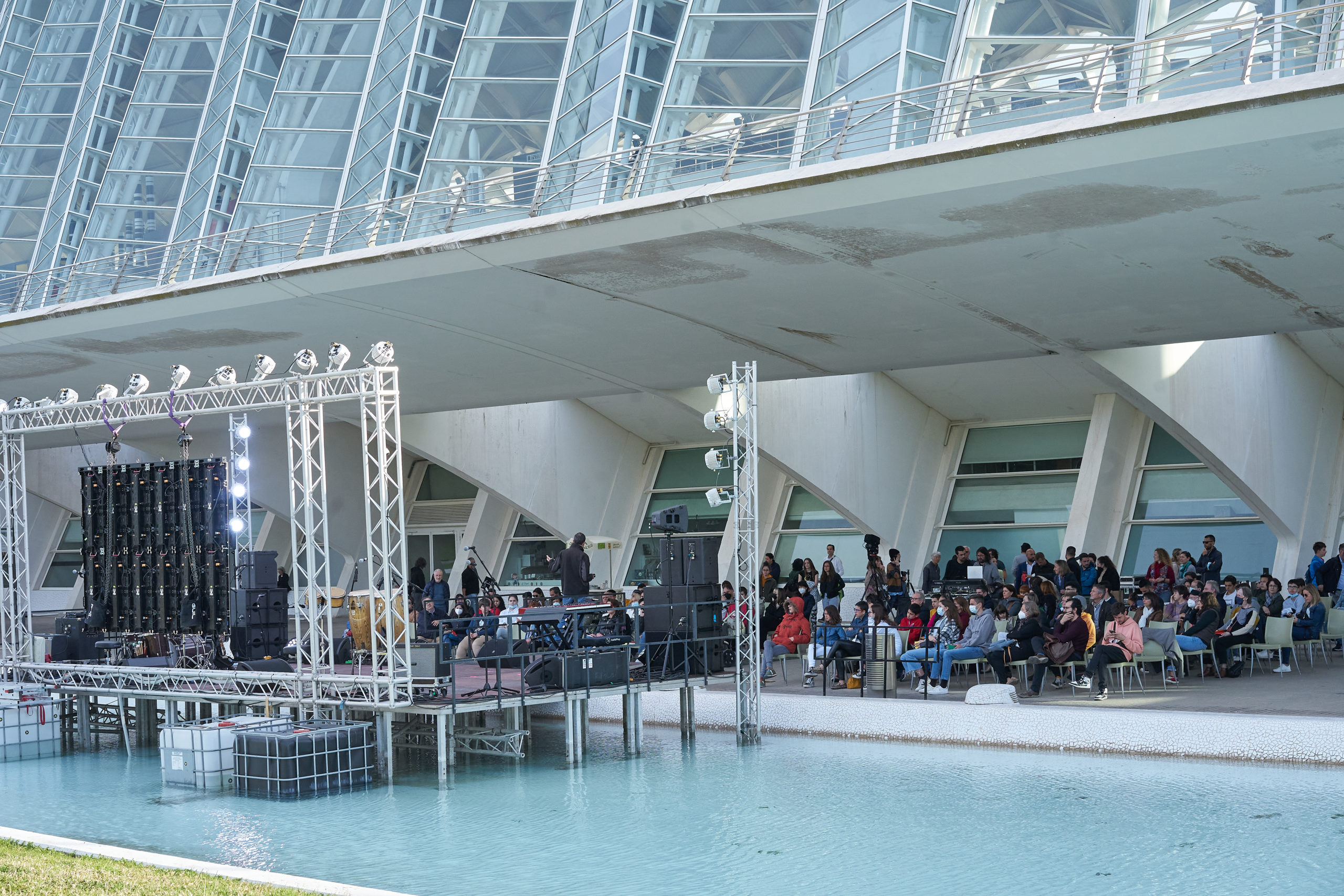
The event will start at 6 pm on the stage of the northern promenade in front of the Museu de les Ciències, with the participation of the group of science popularizers “Big Van Science”, who will perform different experiments.

The show will follow a narrative in which science helps us to understand climate phenomena and to face the problem of global warming. To this end, the two main characters, two scientists dedicated to the study of climate change, will be assisted by the audience to illustrate several key concepts, such as the effect of combustion on CO₂ emissions (it will be shown how burning fuels generates large amounts of carbon dioxide) and the impact of CO₂ on the climate and the oceans (using carbonic snow to demonstrate how a higher concentration of CO₂ increases heat retention, contributing to global warming).

The science outreach company Big Van Science will also explain the acidification of the oceans by dissolving CO₂ in water and turning it into carbonic acid. All of this will be done in an interactive way, inviting volunteers from the public to participate.

Strategies for reducing the amount of carbon dioxide released into the atmosphere will also be discussed, ranging from reducing the use of fossil fuels to developing biofuels from organic waste, such as bioethanol. Finally, sustainable transportation will also be discussed, and eco-friendly rockets will be built and launched alongside attendees.

We talked about sustainability and agri-food strategies in the VC

The Foundation has organized a conference dedicated to sustainability in the Valencian Community, which was held at the Cajamar facilities where several speakers were present to discuss about the issue.

Eduardo Rojas, forestry engineer, denounced, when referring to the Poyo ravine that “no one has said that one of its problems was the amount of abandoned agriculture that it housed, which led to its overflow” and denounced the injustice of focusing on negative environmental economic instruments and ignoring the positive ones. Rojas, who is also a professor at the UPV, spoke of the territorial challenges we face, such as the collapse of the proposal of the rural world, and emphasized that today, “we have fewer fires, but the few that there are, burn more every day and are more virulent”. For Rojas, “we intend to solve the challenge of fires by attacking the consequences, but not their causes.” Montes, in addition, proposed to “address the smallholding, strengthen the regional step for the provision of services and adequate dimension, ensure a fair and stable legal framework to provide environmental services, train and educate the population in cases of emergencies, increase employment in rural areas, depoliticize agricultural organizations, motivate young people to study careers or recover the value of the Mediterranean diet,” among the many proposals he made in his speech dedicated to territorial, environmental and social challenges.

The day began with the welcome of the territorial director of Cajamar, Jesús García, as well as Angel Marhuenda, director of the CAP (Common Agricultural Policy) who, together with the president of the Rei Jaume I Prizes Foundation, Javier Quesada, gave way to the various interventions.

Thus the director of the Cajamar Group Foundation, Manuel Laínez, defended “reducing the size of companies and relaxing the obligation of the need to implement emission reduction schemes”, for example . Regarding climate change, Laínez stressed that “we have exceeded the level of 1.5 degrees and this year we continue with very high averages, increasingly higher temperatures and more rainfall. The advance of technology facilitates innovation with engineering“ and explained all the tools that we have dedicated to biotechnology” that serve us for everything related to plant material that will make it more resilient and resistant to diseases and pests, with the improvement of natural resources and their use, in addition to the incorporation of functional ingredients”. For Laínez, “when we are efficient, we manage to reduce the environmental footprint and we will be more competitive”. According to the director of the Cajamar foundation, the industry of the future “is going towards a control in the cloud connected with new products that incorporate AI responding to the needs of producers and that we see already in farms today where they have controlled the entire value chain of the product from the field to the warehouse with several parameters: efficiency, reduction of emissions of footprints, with simulation in the twin chain that help them to experience how it would be: organization, innovation, digital transformation, incorporation of new technologies and chain strategy.” In addition, he denounced that “since 2018 there has barely been an increase in R&D investment in Spain, with barely 0.8 investment in innovation. And we have been supporting investment for 50 years in the agri-food chain trying to get it wrong ourselves so that the farmer does not. With special incubator projects for new companies,” defended Manuel Laínez.

The general director of industry and agri-food chain, Ernesto Fernandez, spoke of rural development with the issue of depopulation as the main problem we face, and recalled that “90% of the population is concentrated in 30% of the territory” with the case of Castell de Cabres, less populated municipality of the whole CV in the Bajo Maestrazgo with only 22 inhabitants, as the maximum exponent. Fernandez said that “in Castellon there is 81.41% of municipalities with less than 3,000 inhabitants, which are 110 municipalities and in the province of Valencia, it is the Rincón de Ademuz who leads the depopulation data”. For the general director, the common denominator that unites all the depopulated villages “is agriculture, where young farmers only represent 5.18% and half of the farmers are over 65 years old, in addition to the fact that 35% of those affiliated to the SS have been lost. And in 2023 we reached 173,676 ha. abandoned or, what is the same, 2,290 ha. more than the previous year and we are leaders in Spain in land abandonment” he emphasized.

Tomás García Azcárate, a specialist in the CAP, reflected on various issues related to the subject: “agriculture exists to produce food, but it must do so in a sustainable manner, there is climate change and farmers are among its victims and called for the search for orange varieties, for example, ”to achieve a better balance between the cold and heat caused by climate change”. For Garcia, “adaptation and mitigation of climate change is for everyone and it is better to convince than to win. Von der Leyen’s first commission was a despotic bureaucratic coup“ he denounced and reaffirmed that ”the despotism of the Green Deal is still present”. For the CAP specialist, “Spanish agriculture is doing well, but the middle class of family farmers are not faring well. There is not enough money for everyone and everything, so aid to farmers must go to those who need it, and large entrepreneurs who are doing well do not need help to develop further,” he recalled. “The priority, he says, should be to accompany the rural middle class, 97% of the agricultural population, professional family members towards agriculture 4.0 and agroecological transition.” In addition, he added that “the administration can and should help to build a more balanced food chain”.

Testimonials

In the turn of the testimonies, there have been six representatives of various companies that participated to narrate their experiences in sustainability, thus, Carlota de Dios spoke about the @TierraBobal tourism destination brand “integrated offer with some landscapes and wine offers, wine tourism, gastronomic tourism, etc. we are a system and we do not realize” she said referring to sustainability “as the ability to endure over time”.

Vicent Faro, farmer, organic producer, president of the @CAECV spoke of the three daily challenges: territorial, environmental and social along with innovation to help sustainable production and explained the various standards that certify organic production.

Javier Gandía, director of Bodegas Vicente Gandía, explained the different certifications that endorse his brand that covers about 500 ha. of vineyard area spread over different areas with sustainable agriculture and various projects such as the last one to which the funds raised are dedicated to a foundation for the protection of animals.

Carmen Morales, director of quality and sustainability in Anecoop explained the various tools in sustainability for the cooperative’s members, “now is the time” he said about the cooperative with more than 20. 000 members in Spain whose commercial network extends all over the world, although she acknowledged that “sustainability is not yet really integrated”.

The doctor and agricultural engineer and professor of the department of economics and social sciences Olga Moreno called for a change in the architecture of choice that pushes us to buy certain foods in the markets, “in our daily lives we are pushed to choose between A or B, so we should be directed towards sustainable products and they should be promoted, with reliable easy to read labels, that help us in make quick decisions, that is, that  what is sustainable is easily eligible and economical” she claimed while appealing to society’s responsibility.

And finally, Inmaculada Sanfeliu spoke about Intercitrus, phytosanitary defense, research with CRISPer and the promotion so demanded by the sector. She exposed the example of ZUVamesa as a paradigm of sustainability, an example in these energetic, environmental issues of zero waste, etc. that arose “from the need to promote a promotion industry for citrus fruits that cannot go to the fresh market.” Sanfeliu recalled that “the citrus sector ranks third in the Valencian Community, where one out of every four oranges exported in the world are Spanish, and more than 70% of the citrus trade is made from the Valencian Community, with 175,000 trucks leaving each year, 307,000 ha. or the equivalent of 330,000 soccer fields that would absorb between 1’7 million tons of CO2” he concluded.

We talked about Korea-Huntington’s disease.

The Foundation organizes a course to give visibility to a rare disease, Korea-Huntington’s.

It is a disease that produces abrupt and uncontrollable movements that make the life of patients very uncomfortable and as it is very unknown, they usually do not have the necessary social support.

Although it is a genetic disease, it worsens like all neurodegenerative diseases during aging and causes premature death of the patient.

The course was given by Dr. Minichiello, an Italian neuroscientist from Oxford University, with more than 30 years of research in this area and for the last 15 years she has been trying to explain the biochemical bases that cause the death of a specific group of neurons that control our coordinated movements.

On the other hand, another speaker was Dr. Garcia de Yébenes, winner of the Rei Jaume I Prize for Clinical Medicine in 2000 and one of the most prestigious Spanish neurologists, as well as one of the specialists in Korea-Huntington’s, who explained the chemistry and some treatments to improve the lives of these patients because at the moment, there is no way to prevent or cure this disease.

In the words of the course coordinator, Dr López Ruiz of Cardenal Herrera University, “the purpose of this conference is twofold. Firstly, we want to make health professionals and society in general aware of the need to know more about this rare disease. López thanked the president of the Rei Jaume I Prizes Foundation, Javier Quesada, for his constant support for the medical conferences “despite not being an expert in the field”.

And Dr Bataller, coordinator of the University of Valencia (UV), expressed his satisfaction at being able to teach students “the importance of basic research in the development of better treatments to prevent and combat these diseases”.

If you want to see the recording of the day: