The 35th edition of the Jury Meeting for the Rei Jaume I Prizes will take place on 5 and 6 June

The Foundation launches sinmiedoalaia.es to combat fear of Artificial Intelligence

A creative campaign has been launched focusing on conversational AI, designed to help people learn more about the benefits of this technology for scientific research and business innovation.

A total of 21 Nobel laureates, four of whom will be attending for the first time, will form part of the jury that will select the six winners.


On 5 and 6 June, the traditional Jury Meeting will be held in Valencia to select the six prize-winners of the 35th Rei Jaume I Prizes 2023 in the following categories: Basic Research, Economics, Biomedical Research, Environmental Protection, New Technologies and Entrepreneur.
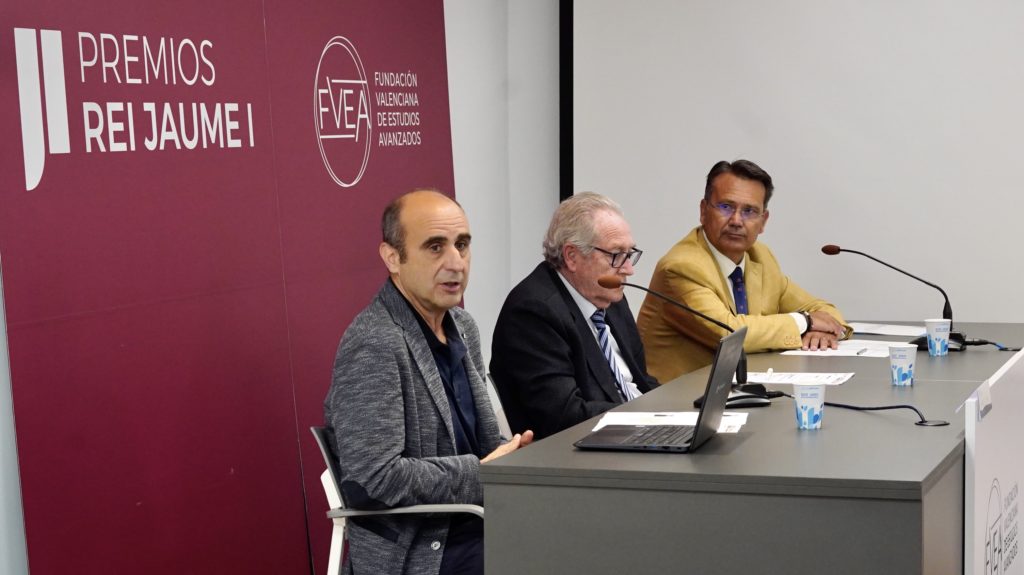
The executive chairman, Javier Quesada, and the chairman of the Fundación Valenciana Premios Rei Jaume I, Vicente Boluda, were responsible for outlining the new developments for this year’s edition, which took place at the Biohub headquarters, where Dinapsis and Health in Code are based, the latter being the company run by the winner of the 2022 Entrepreneur Prize, Ángela Pérez.
This year’s event is being organised, for the first time, by the new Fundación Valenciana Premios Rei Jaume I, which resulted from the merger of the three organisations previously behind the prizes: the Valencian Foundation for Advanced Studies, the Fundación Premios Rei Jaume I and the José Pastor Fuertes Foundation.
This year, the awards jury will comprise around a hundred people, 21 of whom are Nobel Laureates in various disciplines, four of whom will be attending as jury members in Valencia for the first time. They are Klaus Von Klitzing, winner of the 1985 Nobel Prize in Physics (Poland); Dr Anton Zeilinger, winner of the 2022 Nobel Prize in Physics (Austria); Dr Ardem Patapoutian, winner of the 2021 Nobel Prize in Medicine (Greece) and Dr Morten Meldan, winner of the 2022 Nobel Prize in Chemistry (Denmark).
The Jury Meeting is the only event in Europe that brings together such a large number of Nobel laureates. Furthermore, as is the case every year, the jury will be joined by the country’s leading businessmen and businesswomen, as is customary each year on the Entrepreneur Jury.

Creative

Campaign This event is being used to launch a creative campaign aimed at raising awareness of the importance of innovation, science and enterprise for any country. And, at present, Artificial Intelligence lies at the heart of the technological debate. “Society finds itself in a situation where it is unable to assess whether what is being done poses a risk, and in the face of fear, we must provide more information and exercise caution. If we look back at history, we see that fear is dispelled by knowledge. Science and research have been utilising this technology to great effect,” said Javier Quesada during the press conference.
For Prof. Quesada, “Spain must not shy away from a movement that is unstoppable, one that will drive the world’s leading nations forward, and AI must be a key component of this, as it has been up to now. “What the campaign aims to emphasise is that we must put our fears aside and approach this with caution, but that does not mean we should hold back.”
As part of this campaign, the Foundation has developed an artificial intelligence system to help people who are afraid of this technology. It is now operational at sinmiedoalaia.es and has been trained to convey, through conversation, the specific benefits offered by this type of technology.


Events on 5 and 6 June
On the first day – this year, Monday 5 June – the Nobel Laureates will visit numerous institutes and research centres of interest in the Comunitat Valenciana. The following day, 6 June, the programme will begin at the Capitanía General with the reading of the Nobel Prize ‘Jury Declaration’. This will be followed by the jury meetings, during which the six winners of the 35th edition will be selected. Following this, the winners will be announced at the Palau de la Generalitat.

A total of 222 nominations have been submitted for the 2023 Rei Jaume I Prizes

A total of 222 people, 53 of whom are women (25 per cent), are standing this year to be one of the six winners of the Rei Jaume I Prizes, dedicated to promoting research, science and entrepreneurship. The winners will be decided next June by a jury of more than 80 people, including 21 Nobel Laureates.

The category that has received the most nominations this year is Biomedical Research, with a total of 55 nominees, including 15 women hoping to win this coveted award. This is followed by the Entrepreneur Prize, with 47 candidates – 9 of whom are women – vying for the €100,000 prize, and next comes Basic Research, with 38 nominations, 7 of whom are women. New Technologies has 38 candidates this year, 8 of whom are women; Environmental Protection has 28, including 10 women; and the Economy category brings up the rear with 16 nominees, 4 of whom are women.

By region, the Comunitat Valenciana has put forward the most candidates, with 61 people, followed by the Community of Madrid with 51 and Catalonia with 50. It so happens that this year nominations have been received from all Spanish autonomous communities, with the exception of the autonomous cities of Ceuta and Melilla.

“Music is society’s medicine”

A conference dedicated to ‘Music in the Comunidad Valenciana’ was held, featuring contributions from experts and a chamber music concert to round off the event

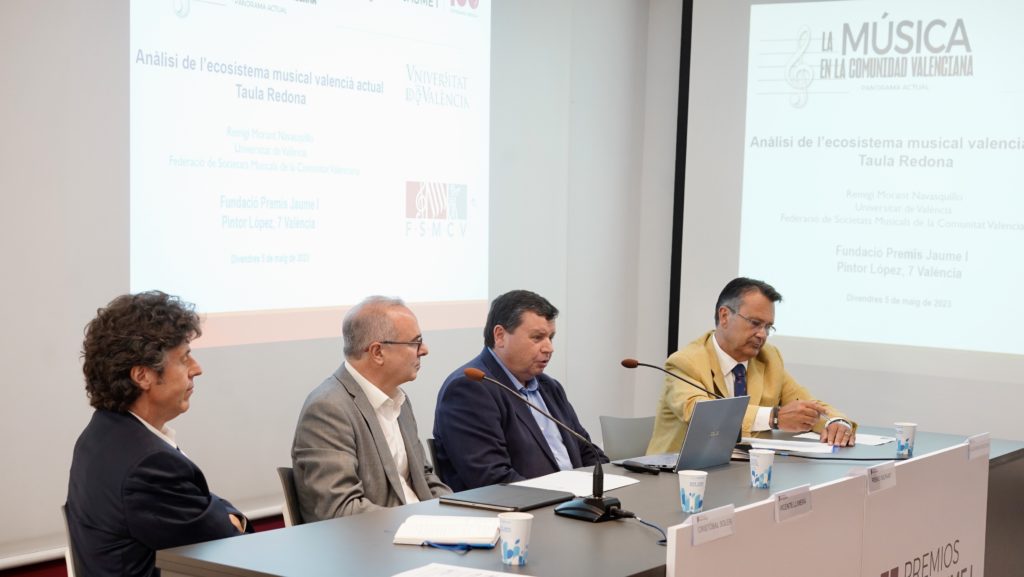
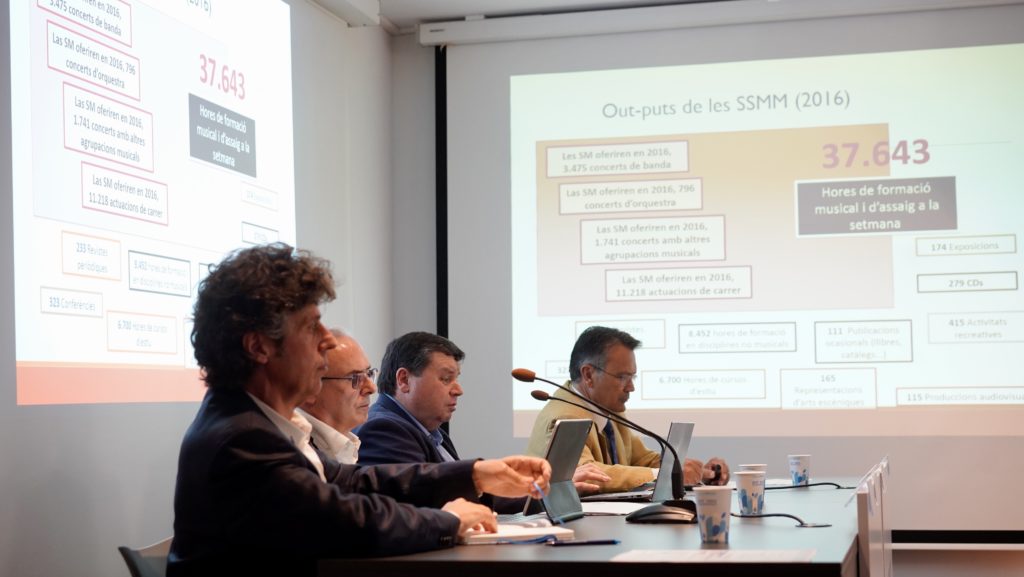
The Foundation has held a conference dedicated to Music in the Comunidad Valenciana, which featured discussions on musical societies and their history in the region, as well as an in-depth examination of the current Valencian music scene.

The event featured the academic consultant for ESMAR (Higher School of High-Performance Music), Manuel Tomás, for whom “musical societies are a backbone of the Valencian Community, with 550 musical societies, over 1,000 brass bands, more than 47,000 musicians, nearly 60,000 students, more than 200,000 members, 600 educational centres and more than 5,000 teachers, with nearly a million supporters”, which, according to Tomás, “is something that happens nowhere else in the world”. The music expert has championed the figure of the Valencian amateur musician, “people who, with barely any ability to read or write, would go to play music after finishing their working day in the fields or in the factory. Many of them, illiterate or almost so, enjoyed their contact with music; in fact,” Tomás continued, “95 per cent of the bands were made up of this sort of person”.

Tomás spoke about the musical societies, “which are present throughout the Valencian region and serve as a backbone and a major force for social cohesion,” he said. He also explained how “legally, they are non-profit organisations, born out of Valencian civil society with a history stretching back almost 200 years, which proliferated in the second half of the 19th century and have continued to grow ever since”.

For Tomás, who is also the coordinator of this event, “musical societies were originally a rural phenomenon, but they have now also taken root in the city of Valencia, as the practice of music in the streets is an expression aligned with the concept of ‘Mediterranean identity’, in which the pairing of ‘music and celebration’ is ever-present.”

The subsequent discussion was moderated by Alejandro Monzonís, CEO of Iale International School, who expressed his hope that the subject of music would be given the importance it deserves, as “music enhances logical reasoning, fosters critical and analytical thinking, and if a child, is exposed to a musical instrument from a young age, we will be helping them to improve those skills,” he said.

To analyse the Valencian music scene, the vice-president of the Federation of Musical Societies of the Valencian Community, Remigi Morant, boasted that “we in the musical societies did not feel the economic crisis; on the contrary, enrolment figures have risen because parents felt it was a safe bet for their children to study music”, whilst Vicente Llimera, professor of oboe at the “Joaquín Rodrigo” Higher Conservatoire of Music in Valencia, explained the various higher education music programmes in the region, such as the ECTS, “the European recognition programme, such as Erasmus, which has enabled us to interact with other countries and develop joint European programmes”. Llimera also emphasised the fact that “today, 60 per cent of music graduates hold a PhD, and the qualifications framework now brings us into line with Europe”.

To conclude this discussion, the Maestro and Conductor, Cristóbal Soler, expressed his delight that “the fact that a foundation such as the one behind these awards has approached us is in itself a source of pride and speaks volumes about our society”. At various points during his speech, Soler expressed his gratitude to the musical societies, from which all young Valencian musicians emerge, “because thanks to these societies, we have the best musicians in the world”, he stated emphatically. He also expressed his satisfaction that “the world is beginning to recognise us, as in Vienna with the University of Valencia Orchestra, which exists thanks to the pool of talented young people and which, since 2003, has meant that Spaniards now make up the majority of the successful European Gustav Mahler Orchestra, where we had virtually no representation just a few years ago”. Finally, the young conductor paid tribute to music as “the medicine of society, as it is a form of knowledge that saves and heals”.

To conclude, a tribute was paid to music with two saxophone and wind quartets from ESMAR, who performed two short pieces of chamber music.

Watch a video summary of the day’s events